- Up 41.2% since June ‘25/YoY
- Lending rates halve, but margins tighten
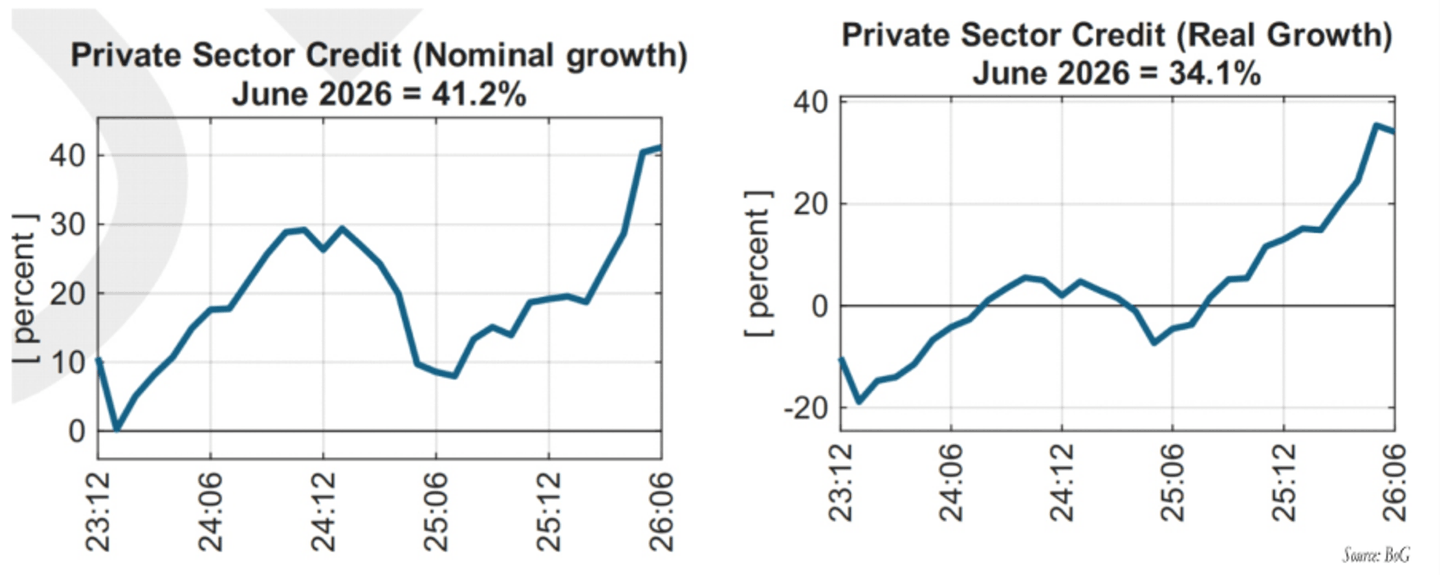
Credit to the private sector expanded 41.2 percent year-on-year in June 2026 to GH¢119.6billion, one of the fastest paces on record, according to data published by the Bank of Ghana (BoG).
The figure, contained in the Summary of Economic and Financial Data, represents a marked acceleration from the 19.2 percent recorded in December 2025 and 8.6 percent a year earlier. In real terms, adjusted for consumer prices (inflation), credit grew 34.1 percent to GH¢44.2billion – expanding at a pace more than five times that of the economy, which grew 6.4 percent in the first quarter.
The expansion has coincided with a steep decline in the cost of borrowing. The average lending rate fell to 15.64 percent in June from 27 percent a year earlier, while the Ghana Reference Rate (GRR) which anchors loan pricing dropped to 10.02 percent from 23.8 percent over the same period.
Sector anchor
Banking sector data show the credit push is being funded by a broader balance sheet. Total deposits rose 32.4 percent to GH¢370.8billion and total assets grew 30.7 percent to GH¢502.4billion in tandem. The total stock of advances also increased 38.6percent to GH¢124.3billion.
The BoG data point to a reallocation within bank portfolios rather than growth alone. Claims on government fell to GH¢124.8billion in June from GH¢136.2billion in April, while claims on the private sector rose to GH¢120.7billion from GH¢111.4billion over the same period.
The shift follows a collapse in short-dated government paper yields. The 91-day Treasury bill closed June at an interest equivalent of 5.27 percent, down from 14.74 percent in June 2025 and below the 5.3 percent headline inflation rate recorded for the month.
The banking industry’s asset quality and capital indicators have improved alongside the expansion. The Non-Performing Loans (NPLs) ratio fell to 16.1 percent from 23.1 percent a year earlier and to 4.6 percent from 8.5 percent when the loss category is excluded. The capital adequacy ratio stood at 20.4 percent, up from 19.7 percent with no reliance on regulatory reliefs.
BoG Governor Dr. Johnson Asiama, while briefing the press at the conclusion of the Committee’s 131st regular meetings , however highlighted lingering risk concerns.
Speaking of the banking performance, he said: “Notwithstanding these improvements, elevated risk remains a key vulnerability and continued adherence to prudential and regulatory measures are expected to further strengthen asset quality and reduce the level of NPLs across the industry”.
Profitability metrics, however, have moved in the opposite direction. The net interest margin narrowed to 9.6 percent from 12.4 percent a year earlier. Return on assets before tax fell to 4.4 percent from 5.6 percent and return on equity after tax to 22.9 percent from 32.2 percent. Operational cost to gross income rose to 53.3 percent from 48.4 percent.
Backdrop
The credit acceleration is occurring as disinflation stalls. Headline inflation rose to 5.3 percent in June from a trough of 3.2 percent in March. Non-food inflation reached 6.3 percent while core inflation – excluding energy, utilities and all food items – climbed to 7.1 percent from 2.7 percent in April.
Secondary market bond yields have begun to reprice. The five-year bond traded at 13 percent in June, up from 9.80 percent in May, while the 15-year bond moved to 14.11 percent from 12.1 percent over the same period.
Monetary aggregates have also expanded rapidly. Reserve money grew 31.7 percent year-on-year in June, reversing a 1.4 percent contraction in March. Total liquidity (M2+) rose 28.5 percent, with foreign currency deposits up 32.2 percent after a 13.1 percent decline in March.
The cedi traded at GH¢11.55 to the US dollar as at July 17, 2026 – a year-to-date depreciation of 9.5 percent, having been at GH¢10.45 at end-December 2025.
Gross international reserves stood at US$12.94billion at end-June and covered five months of imports, down from US$14.16billion in March.
Brent crude averaged US$84.1 per barrel in June, down from a peak of US$103.7 in May but 36.5 percent above the December 2025 level. Oil imports reached US$3.35bn in first half-2026, up from US$2.41billion for the corresponding period of 2025.
SOURCE: https://thebftonline.com/article/private-sector-credit-hits-gh-119-6bn