… with increased CAPEX targetted
The change was agreed with the International Monetary Fund (IMF) as part of the 36-month Policy Coordination Instrument (PCI) that will replace the Extended Credit Facility (ECF) programme and be submitted to the House as a bill accompanying the 2027 budget.
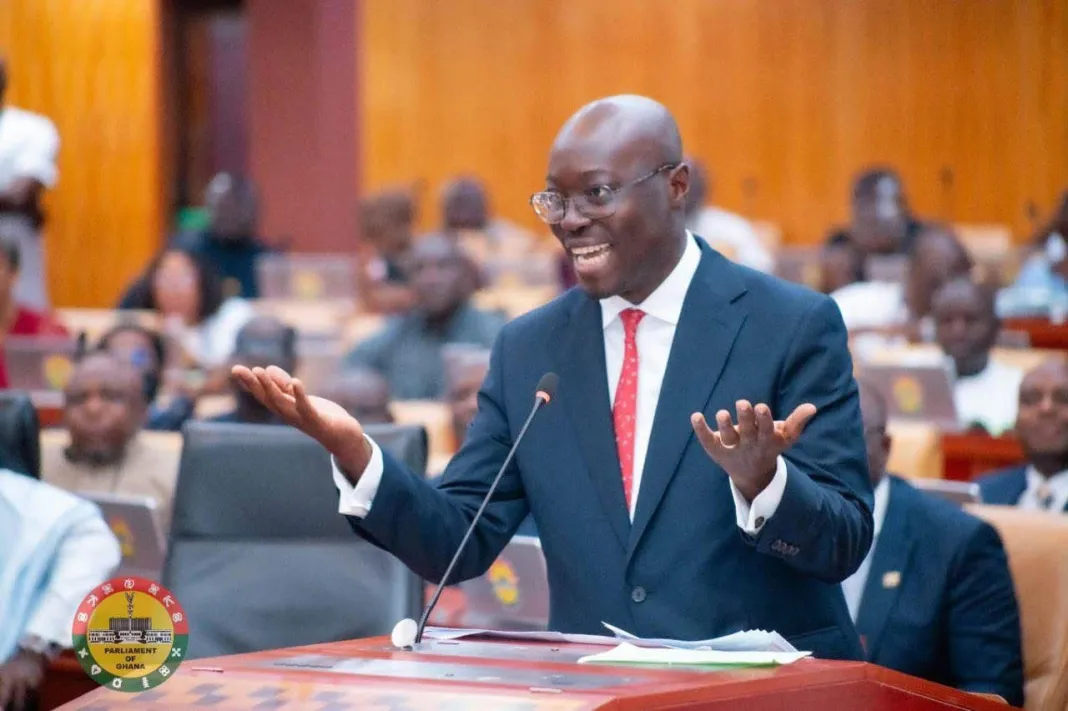
“Government will under the PCI reduce the primary surplus target on a commitment basis, from 1.5 percent of GDP to 0.5 percent of GDP from 2027 onward,” Dr. Forson said.
The minister stated that fiscal space created by the adjustment will be dedicated exclusively to capital investment.
“The fiscal space created will be used exclusively to finance growth-enhancing capital expenditure that supports infrastructure development, boosts productivity, stimulates private sector activity, promotes sustainable job creation and long-term economic development,” he told the House.
Act 1136, passed in 2025, established a binding minimum annual primary surplus at 1.5 percent of GDP alongside a debt-to-GDP ceiling of 45 percent. Both were presented at the time as anchors designed to hold across electoral cycles. The bill to amend the primary balance rule will come before parliament roughly eighteen months after the original provision took effect.
Overperformance as the basis
Government’s case rests on having comfortably exceeded the rule in its first year of operation. The 2025 full-year outturn recorded a primary surplus of 2.5 percent of GDP on a commitment basis, a full percentage point above the statutory floor, while the overall fiscal deficit on the same basis came in at 1 percent of GDP against a 2.8 percent target.
The debt ratio fell from 61.6 percent of GDP at end-2024 to 44.7 percent at end-2025 and stood at 45.0 percent at end-June 2026.
“Ghana has therefore already achieved its statutory debt target of 45 percent of GDP – years ahead of both the IMF programme timetable and the target date established under the Public Financial Management Act,” Dr. Forson said.
The joint IMF–World Bank Debt Sustainability Analysis has also moved Ghana from ‘sustainable’ to ‘sustainable with room to absorb shocks’, while the external and overall risk of debt distress was upgraded from high to moderate – the first such improvement since April 2014.
The minister linked this loosening directly to the consolidation already achieved. “The significant fiscal consolidation achieved in 2025 has created fiscal space to scale up strategic investments for expanding employment opportunities -particularly for the youth – and accelerating economic transformation,” he said.
Fiscal consolidation in 2025 was substantial by any measure. Total expenditure on a commitment basis fell from 22.7 percent of GDP in 2024 to 16.6 percent in 2025, with primary expenditure down from 18.7 to 13.2 percent – a 5.5 percentage point compression in a single fiscal year. The economy nonetheless grew 6 percent, the fastest since 2019.
Capital expenditure bore much of the adjustment as it was compressed to 0.8 percent of GDP over the first three quarters of 2025, with Annual Budget Funding Amount utilisation running at 0.43 percent of the period target through September. Capital spending recovered to GH¢22.2billion in first half-2026, of which GH¢6.5billion went to the Big Push infrastructure programme.
Sequencing questions
The amendment will take effect before full operationalisation of the two institutions established to police fiscal performance.
Under the PCI reform schedule tabled with the Review, the Fiscal Council is to be fully operationalised by end-September 2026 through the appointment of a Head of Secretariat, staffing from the Ministry of Finance and Bank of Ghana and data-sharing memoranda among relevant agencies. The Value for Money Office carries a target date of end-June 2027.
The PCI’s own quantitative targets show the loosening’s profile. The cumulative primary balance floor is set at GH¢24.65billion for December 2026 before turning to a deficit floor of GH¢6.5billion by June 2027 and recovering to a surplus of GH¢9.07billion by December 2027.
Targets maintained
Government maintained all 2026 macroeconomic targets in the Review, including the 1.5 percent primary surplus for the current year. The half-year outturn recorded a primary surplus of 0.9 percent of GDP on a commitment basis against a target deficit of 0.2 percent, with the overall commitment balance at a deficit of 0.4 percent against a 2 percent target.
Post-programme framework
The anchor revision forms part of a broader shift in Ghana’s relationship with the Fund. The IMF Executive Board is expected to approve the sixth and final review of the three-year US$3billion ECF by end-July, releasing a final tranche of SDR265.9 million, or approximately US$370 million.
Ghana met ten of eleven quantitative performance criteria and eight of ten structural benchmarks under the programme, against ten of thirteen and three of eleven respectively at the close of the 2015–2018 arrangement.
The PCI carries no financing. It however commits government to 26 reform targets through December 2027 across fiscal transparency, debt sustainability, monetary policy, financial sector stability and diversification, monitored through semi-annual reviews.
Dr. Forson described the transition as a change in standing rather than a departure.
“We have evolved from a position of ‘supplicant’ to one of ‘partner’,” he said.
He added that the arrangement was intended to demonstrate the past eighteen months of policy’s durability. The PCI, he said, is “a structured internationally monitored platform through which Ghana commits to a specific set of macroeconomic and structural reform policies, submits to regular independent review and signals to the world that the past eighteen months’ discipline is not a temporary posture adopted under crisis conditions”.
No supplements
Government did not seek a supplementary estimate in the Review. Total appropriations and expenditure on a commitment basis remain unchanged, with a realignment within the existing envelope allocating GH¢5billion to the Ghana Accelerated National Reserve Accumulation Policy (GANRAP) and reducing foreign-financed capital expenditure by GH¢3billion.
Under the PCI, the debt-to-GDP ratio set out in Act 1136 will continue to serve as the principal fiscal anchor.
SOURCE: https://thebftonline.com/article/gov-t-to-halve-fiscal-anchor-to-0-5-of-gdp-from-2027