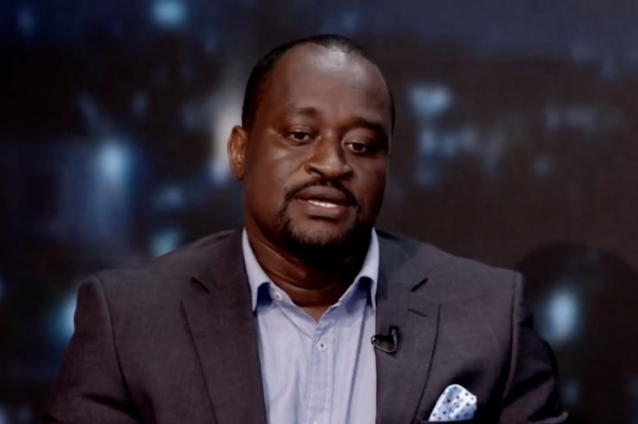
Economist and political risk specialist Dr Theo Acheampong says Ghana must focus on strengthening its internal economic management amid rising geopolitical shocks that are becoming more frequent and unpredictable.
Speaking on Joy News’ PM Express Business Edition on Thursday, Dr Acheampong warned that the global environment has changed, with major geopolitical disruptions now occurring far more often than in the past.
“Gone are the times when every maybe 10 or so years, you would have a major geopolitical event.”
According to him, recent global developments show that shocks to the international system are now more regular.
“But what the last few years have taught us is that you should expect these things much more often than not.”
He cited the ongoing Russia-Ukraine war as an example of how global events can quickly send shockwaves through economies worldwide.
“To the point that we’re just coming off. In fact, we’re still in Russia, Ukraine, and then the initial period, the shock that was sent to the whole world with the inflationary spike, and then the cost of living pressures, and then related governments having to make, you know, certain adjustments.”
Dr Acheampong noted that Ghana’s growing integration into the global economy means external shocks will increasingly pass through into the domestic economy.
“But if you look at the situation that we’re in now, where you expect these geopolitical events to be much more pronounced, and number two, the fact that the Ghanaian economy now is heavily integrated as part of the global ecosystem, for sure, you would see some of these pass-through effects come.”
He argued that while countries cannot control external events, they can control the strength of their internal economic fundamentals.
“What then is interesting and important is, if you assume that geopolitical uncertainty is the order of the day, what do you do as a country to respond to that?”
“So that’s what happens externally, you don’t really have much control over it. What you have control over is what you do internally.”
He stressed that fiscal discipline and economic management will determine how resilient Ghana becomes in the face of global shocks.
“So what you do internally becomes two or three things: what you do in terms of your fiscal performance, how you overmanage the overall economy.”
Dr Acheampong recalled that Ghana entered its 17th IMF programme with significant fiscal vulnerabilities.
“So remember that when we entered the 17th IMF program, there was a statement that the fund issued in the May 2023 report that Ghana had underlying fiscal vulnerabilities.”
He said those weaknesses amplified the impact of global shocks such as the Russia-Ukraine war.
“That is why, when Russia-Ukraine happened, we felt the impact much more than we should have, and at one point, you even had the import covers around two weeks or so of reserves.”
But he noted that Ghana’s external position has improved significantly since the crisis peaked.
“The situation is completely different now than it was in 2022/23.”
He pointed to stronger trade balances and higher reserves as key indicators of improved resilience.
“And the biggest indicator of your ability to withstand some of these shocks, really comes down to looking at your trade balances.”
Dr Acheampong said official data from the Ministry of Finance and the Bank of Ghana show the country is now in a stronger external position.
“If you look at those numbers, and you actually compare where we were a few years ago to where we are now, your import cover is around 5.7 months, and that is still growing.”
He added that Ghana is also recording a positive trade balance.
“So the net trade balance is around a positive 1 billion every month. And then, if you look at the current account, is around $750 million or so.”
This improvement, he said, strengthens Ghana’s ability to absorb global shocks.
“So all of this translates into a much better, improved external position for Ghana, and our ability to actually be able to withstand the shocks relative to where you were a few years ago.”
Asked whether this means the country now has buffers against external shocks, Dr Acheampong said Ghana has made some progress but must continue reforms.
“We have some savings to be able to help address these shocks if the pass-throughs come, of course, you have to do more.”
He stressed that deeper structural reforms are still needed to further strengthen the economy.
“But what I’m saying is that your first line of impact with these global event and these shocks would come you feel it immediately from the external side, and your trade balances, your current account, and we are in a much better position now from what we have in terms of reserves to be able to augment or support or withstand the shocks.”
SOURCE: JOY ONLINE