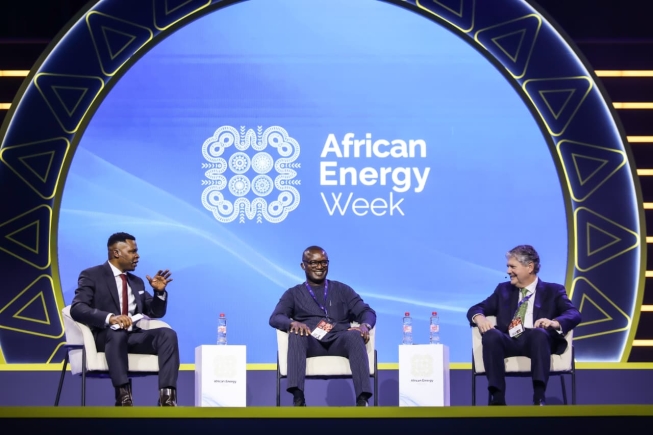

Government expects the economy to outperform the International Monetary Fund’s revised growth forecast of 5.7 percent for 2026, with Finance Minister Dr. Cassiel Ato Baah Forson attributing the improved outlook to fiscal discipline and reforms aimed at restoring macroeconomic stability.
The IMF raised its projection from 4.6 percent in April, an upward revision of 1.1 percentage points that reflects improving prospects for economic activity.
The finance minister however said government is confident growth will exceed the Fund’s latest estimate.
“The IMF has upgraded Ghana’s 2026 growth forecast from 4.6% to 5.7%. We are confident we will exceed that projection,” he said on the sidelines of ongoing IMF-World Bank Annual Meetings in Bangkok, Thailand.
The minister’s assessment comes as domestic economic indicators point to stronger activity, although rising global energy costs, geopolitical tensions and potential inflationary pressures present risks to the outlook.
Dr. Forson made the remarks after meeting Director-IMF African Department Zeine Zeidane, with discussions focused on Ghana’s economic performance and reforms under the Fund-supported Extended Credit Facility (ECF) programme.
Mr. Zeidane commended the country’s progress, describing the programme’s implementation as successful and suggesting that other countries could learn from Ghana’s experience.
“I want to first commend you on how you are performing. The ECF was a great success,” he said, adding that the Fund is encouraging other countries to follow Ghana’s approach.
He also welcomed government’s application of artificial intelligence in Customs administration and reforms involving state-owned enterprises and stock-flow adjustments, areas relevant to revenue mobilisation, public financial management and fiscal transparency.
The IMF official’s endorsement provides external validation of government’s reform agenda, although sustaining the recovery will depend on translating improved macroeconomic conditions into durable growth while containing fiscal and inflationary risks.
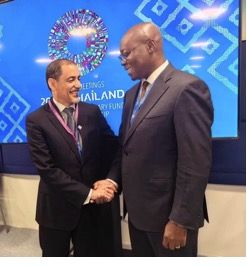
Dr. Forson said government remains committed to maintaining fiscal credibility and discipline, arguing that the progress achieved so far has created a foundation for stronger economic performance.
“Today we have turned the tide. We are moving in the right direction,” he said, while cautioning that the next phase of recovery will require careful management.
Domestic activity supports growth outlook
Data from the Bank of Ghana indicate that real gross domestic product expanded by 6 percent year-on-year in second quarter-2026, driven mainly by the services and industry sectors. However, this was below the 6.6 percent recorded in the corresponding period of 2025.
Non-oil GDP growth slowed to 5.4 percent from 8.5 percent over the same period, highlighting differences in pace of expansion across the economy.
The Composite Index of Economic Activity recorded annual growth of 14.9 percent in July compared with 6.1 percent a year earlier. Increased private-sector credit, international trade and consumption of goods and services contributed to the improvement.
Business and consumer confidence surveys conducted in August also indicated positive sentiment, supported by the relatively stable macroeconomic environment and improved expectations for growth.
Monetary conditions have become more supportive of private-sector activity. The average commercial bank lending rate declined to 15.9 percent in August from 24.2 percent a year earlier, while private-sector credit growth accelerated to 35.5 percent from 13.3 percent.
Government’s fiscal position also improved during the year’s first seven months. The overall deficit on a commitment basis stood at GH¢3.5billion, equivalent to 0.2 percent of GDP, against a budget target of GH¢31billion or 1.9 percent of GDP.
The primary balance recorded a surplus of 1.4 percent of GDP, exceeding the budget target of 0.2 percent. However, public debt increased to 45.9 percent of GDP at end-July from 44.7 percent at end-December 2025.
Stability remains critical
Despite the stronger activity indicators, inflationary pressures could complicate the growth outlook. Headline inflation rose to 5 percent in August from 4.6 percent in July, driven mainly by non-food inflation and the pass-through of utility tariff adjustments and higher crude oil prices.
The Bank of Ghana’s Monetary Policy Committee maintained the policy rate at 14 percent in September, citing a broadly balanced outlook for inflation and growth. The committee expects inflation will move toward its medium-term target band over the coming quarters, while identifying energy costs, exchange-rate movements and global supply disruptions as potential risks.
International conditions could also affect financing costs for emerging markets, as several major central banks have tightened monetary policy in response to renewed inflationary pressures.
Gross international reserves stood at US$12billion as of September 22, equivalent to 4.5 months of import cover and providing a buffer against external shocks.
Dr. Forson said government will avoid taking the recovery for granted, stressing that continued progress depends on preserving the conditions that supported the turnaround.
“And we will take off cautiously. Bear in mind that all the gains we have made are dependent on us maintaining macroeconomic stability,” he said.
SOURCE: B&FTIMES